
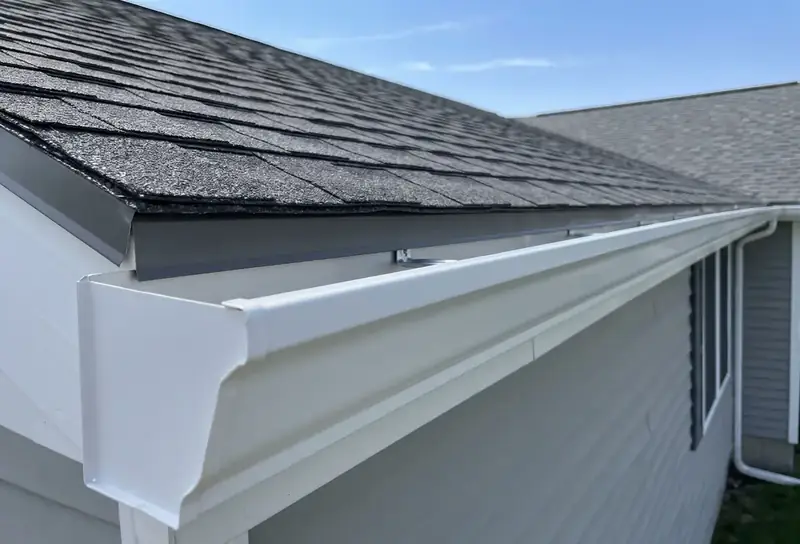
What drip edge does
Without drip edge, water curls under the shingle edge and runs down the fascia, behind the gutter. That rots fascia, stains siding and drips at the foundation. In winter, meltwater that runs behind the gutter freezes there and forces it outward.
Signs it is missing
- Stains or peeling paint on fascia behind the gutter
- Drips between gutter and house
- Soft fascia
- A visible gap between shingles and gutter back
Types
| Type | Use |
|---|---|
| L or D-shaped drip edge | Standard at eaves |
| Gutter apron | Reaches into the gutter |
| Extended drip edge | Where shingles overhang too little |
On older houses
Many older De Pere houses were roofed without drip edge. When gutters are replaced, a gutter apron can often be added under the first course.
Drip edge, gutter apron and ice and water shield
| Part | Where it sits | Job |
|---|---|---|
| Ice and water shield | Under the shingles at the eave | Seals around nails if meltwater backs up |
| Drip edge | Along the roof edge | Throws water clear of the fascia |
| Gutter apron | From under shingles down into the gutter | Bridges any gap between roof and gutter |
| Gutter | Below the roof edge | Collects the water |
In snow country, all four work together. When an ice dam forms, meltwater backs up under the shingles; the ice and water shield limits leaks, and the drip edge and apron keep what does get past the shingles going into the gutter, not behind it.
How a gutter should sit against drip edge
- The back of the gutter tucks behind or below the drip edge.
- The top of the gutter's back edge sits just under the roof plane, not level with it.
- The front edge sits slightly lower than the back, so sliding snow passes over.
- Hidden hangers screw through to solid wood behind the fascia.
A gutter hung too high catches sliding snow and ice and gets torn down. A gutter hung too low lets water drip between gutter and fascia.
Adding a gutter apron to an older roof
On many older De Pere houses, shingles stop short of the gutter and there is no drip edge. When gutters are replaced, an installer can slide a gutter apron under the first course of shingles and let it lap into the new gutter. It is a small part with a big effect on fascia life.
Signs water is getting behind the gutter
- Stained or peeling fascia directly behind the gutter
- Icicles hanging from behind the gutter, not just the front
- Soft wood when probed
- Drips in rain between gutter and house