
On this page
What does a new gutter system include?
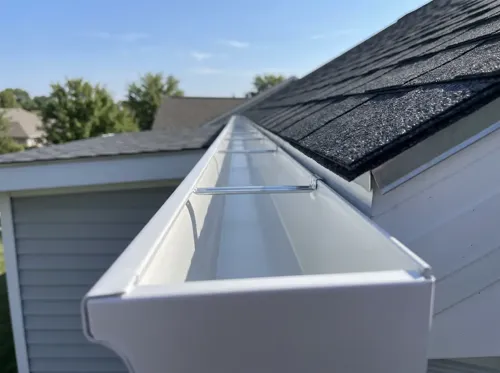
A gutter system runs from the roof edge to the spot where the water soaks in or drains away. A quote should name every part, because a cheap price that leaves out downspouts or fascia repair is not a cheap job.
| Part | What it does | What to look for in a quote |
|---|---|---|
| Drip edge or gutter apron | Metal flashing at the roof edge that sends water into the gutter, not behind it | Whether it is there, or will be added |
| Fascia | The board the gutter is fastened to | Probing for rot; replacement priced per foot |
| Gutter | The trough, usually K-style (ogee) or half-round | Size (5 or 6 inch), metal, thickness (.027 or .032 inch aluminum) |
| Hidden hangers | Screw-in brackets inside the gutter | Spacing, often 24 inches, closer for snow and ice |
| Miters | Corner joints: strip, box or hand-cut | How they are sealed and riveted |
| End caps | Close the ends of each run | Sealed and crimped |
| Outlets (drops) | Holes where water leaves the gutter | Number and position, usually at low ends and below valleys |
| Downspouts (leaders) | Vertical pipes from outlet to ground | 2x3 or 3x4 inch, or round on half-round systems |
| Elbows | Bends at top and bottom, A or B style | Matched to the wall and the outlet |
| Straps | Hold downspouts to the wall | Spacing, and anchors into masonry where needed |
| Extensions, splash blocks | Carry water away from the foundation | Length, and where the water ends up |
How is a seamless gutter installed?
- Take down the old system. Gutters, spikes and downspouts come off, and the fascia is exposed.
- Probe the fascia. Soft or dark boards are marked and replaced, and rafter tails are checked behind them.
- Check the roof edge. If there is no drip edge or the shingles stop short of the gutter, a gutter apron is slid under the first course.
- Snap the pitch. A chalk line sets a slight fall toward each outlet, commonly about a quarter inch per 10 feet. Long runs are often pitched both ways from the middle.
- Form the gutter. A roll-forming machine on the trailer turns a coil of flat aluminum into K-style gutter and shears it to the exact length of each eave.
- Cut outlets and fit miters. Outlets go at the low ends and below valleys; miters are riveted and sealed.
- Hang it. Hidden hangers are screwed through the fascia into solid wood at the chosen spacing.
- Hang the downspouts. Elbows, straps and extensions are fitted so each downspout lands water away from the house.
- Water-test. A hose is run in each section to check flow, joints and discharge.
Which gutter size fits a De Pere house?
| House | Typical gutter | Typical downspouts |
|---|---|---|
| One-story ranch, simple gable roof | 5-inch K-style | 2x3 or 3x4, four to six |
| Split-level or raised ranch | 5-inch, 6-inch where valleys meet | 3x4 |
| Two-story colonial or newer two-story | 6-inch on the back and below valleys | 3x4, more than the builder fitted |
| Older house with shallow eaves | 5-inch K-style or half-round | Round or 2x3, placed carefully |
| Large custom home | 6-inch or 7-inch box on some runs | 3x4 or larger |
Green Bay's wettest month is June, at about 4.1 inches, and a single storm can drop much of that in an hour. Spring melt is the other test: snow that sat on the roof all winter goes down the downspouts in a few warm days. See 5-inch vs 6-inch gutters.
What makes an installation last through a Wisconsin winter?
- Hanger spacing and fastening. Ice is heavy. Hangers every 16 to 24 inches, screwed into sound wood, keep a full gutter from rolling forward.
- Thicker metal. .032-inch aluminum holds its shape under ice and ladders better than .027.
- Correct pitch. A gutter that holds water in November is a block of ice in January.
- Outlets that are big enough. Larger outlets and 3x4 downspouts clog less and thaw sooner.
- Gutter set below the roof plane. A gutter hung high catches sliding snow and gets torn off. The back edge should sit under the drip edge, with the front edge slightly lower.
- Discharge away from the house. Meltwater that lands at the foundation freezes on walks and soaks into the basement wall.
Installation services
- Seamless gutters: aluminum formed on site in one piece per run.
- 6-inch gutters: more capacity for big roofs and valleys.
- Aluminum gutters: the standard choice, in .027 or .032 inch.
- Steel gutters: galvanized and Galvalume for stiffness.
- Copper gutters: 16 or 20-ounce copper for older and higher-end homes.
- Half-round gutters: the traditional profile, on visible brackets.
- Downspouts: sizing, placement, extensions and drains.
What does installation cost?
National cost guides such as Angi and HomeGuide put installed seamless aluminum at about $9 to $13 a foot for 5-inch and roughly $12 to $18 for 6-inch. Steel runs about $6 to $14, and copper about $25 to $40. These are national figures, not local quotes. See what gutters cost in De Pere.
How to check a gutter contractor in Wisconsin
Wisconsin has no state license just for gutter work. What it does have is a permit rule: under SPS 305.31, nobody may obtain a building permit for a one- or two-family home without a Dwelling Contractor certification from the Department of Safety and Professional Services, plus a Dwelling Contractor Qualifier. Homeowners working on the house they live in are exempt. If your job needs a permit, ask the contractor whether they hold both credentials and who will pull it.
Most like-for-like gutter swaps do not need a permit, but work that touches the roof, fascia or drainage can. If you are unsure, the City of De Pere's Building Inspection Division can tell you before work starts; in other towns, call that town's building inspector.
Get the price, materials, downspout plan and any warranty in writing, and ask for proof of liability insurance. If you signed at your home after a salesperson came to you, the FTC's Cooling-Off Rule may give you three business days to cancel.
A note on winter installs
Gutters can be formed and hung in cold weather, and urgent replacements happen in winter. Sealant at miters and end caps cures best on dry metal above freezing, though, and ladders on ice are dangerous. For planned work, spring through fall is the better window. If you book in late summer, the system is up before the leaves drop and the first snow arrives.