
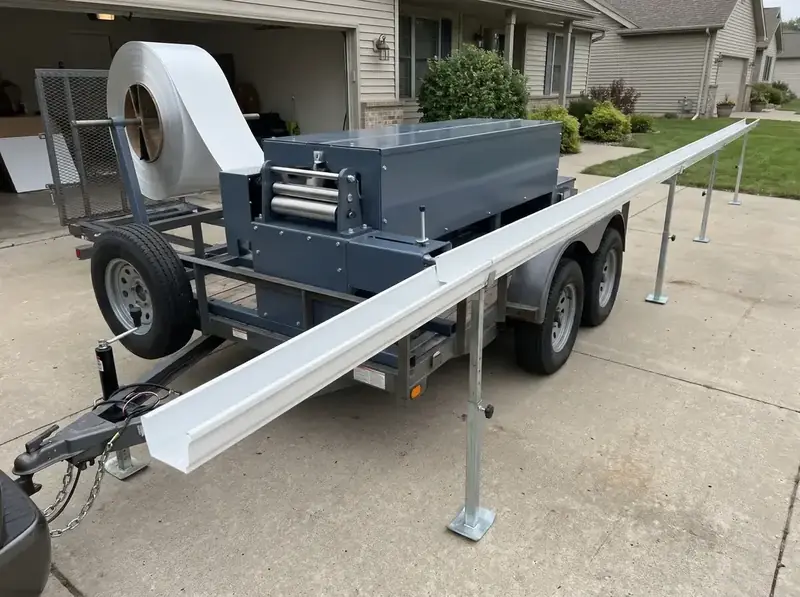
The difference
| Seamless | Sectional | |
|---|---|---|
| Made | On site from a coil | Pre-cut 10 or 20-foot lengths |
| Joints along a run | None | One every 10 or 20 feet |
| Installer | Contractor | Contractor or DIY |
| Leaks | Miters and outlets | Every connector too |
Counting joints on a real house
A ranch with 160 feet of gutter in 10-foot sections has a dozen or more connectors along the runs, plus every corner and outlet. Seamless removes the connectors.
Freeze and thaw
Each joint is sealed with sealant that has to hold through summer heat and winter cold. Green Bay averages about 55.6 inches of snow a season and many freeze-thaw cycles. Fewer joints mean fewer places for that to work loose.
When sectional is fine
- Sheds and small outbuildings
- Short porch runs
- Some half-round and copper systems installed in sections by design
How each type is installed
| Step | Seamless | Sectional |
|---|---|---|
| Measure | Each eave | Each eave |
| Material | Coil on a trailer machine | Pre-cut lengths from a store or supplier |
| Joining | Only at miters and end caps | Connectors every 10 or 20 feet |
| Sealing | Miters and end caps | Miters, end caps and every connector |
| Hanging | Hidden hangers | Hidden hangers or brackets |
Cost over time
Up front, installed prices are similar per foot; national guides put seamless aluminum at about $9 to $13 a foot for 5-inch. Over time, sectional systems tend to need more resealing because they have more joints. In a climate with many freeze-thaw cycles, that maintenance adds up.
Repairs
A damaged seamless run can be cut and patched with a sealed connector, which adds one seam, or replaced as a whole run. A damaged sectional length can be swapped out, which is one area where sectional is easier.
Which suits a De Pere house
For the main runs on a house, seamless aluminum in .032-inch coil, hung on hidden hangers at close spacing, is the common choice. Sectional makes sense for sheds, short porch runs and some half-round or copper systems.