
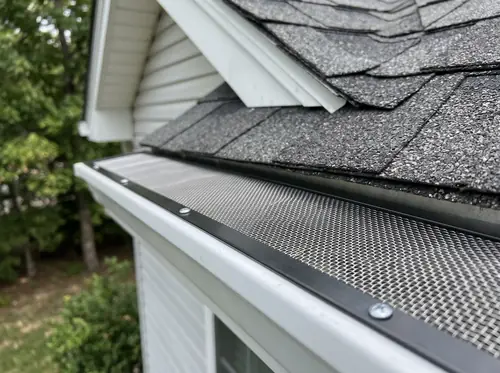
Guard types compared
| Guard | Small debris | Large leaves | Ice | Cost |
|---|---|---|---|---|
| Plastic or wire screen | Poor | Fair | Fair | Low |
| Perforated aluminum cover | Fair | Good | Fair | Low to medium |
| Reverse-curve hood | Fair | Good | Can hold ice at lip | High |
| Foam or brush insert | Poor | Fair | Holds water | Low |
| Stainless micro-mesh | Good | Good | Sheds like roof edge | Medium to high |
How screens and covers are installed
- Clean the gutter.
- Fit the screen or cover to the gutter lip and roof edge.
- Fasten with clips or screws.
- Fit around miters and outlets.
- Test with water.
Where they fall short here
Screens and perforated covers stop big leaves but let maple seeds, linden flowers and small leaves lodge in the openings. Reverse-curve hoods can ice up at the lip, and foam holds water that freezes. In De Pere, where small debris and ice are the main issues, micro-mesh usually performs better. See micro-mesh gutter guards.
When a cheaper guard is fine
Under a single small tree, or where only large oak leaves fall, a screen or perforated cover can keep the worst out at low cost. Where maples, lindens and crabapples drop seeds and flowers, small debris works into the openings and the guard needs cleaning almost as often as an open gutter.
Installing screens on existing gutters
- Clean and flush the gutter.
- Fix sags and leaks.
- Fit the screen under the shingle edge or to the front lip, as the product requires.
- Fasten with clips or screws.
- Trim at miters and outlets.
Reverse-curve hoods and ice
Hooded guards rely on water following a curve into a slot at the front. In freezing weather, that slot can ice over, and water and snow run off the front instead. In a place with about 55.6 inches of snow a season, that is worth weighing.
In short
Screens and hoods are cheaper than micro-mesh, and in the right place they are enough. Under trees that drop seeds and flowers, they usually are not.